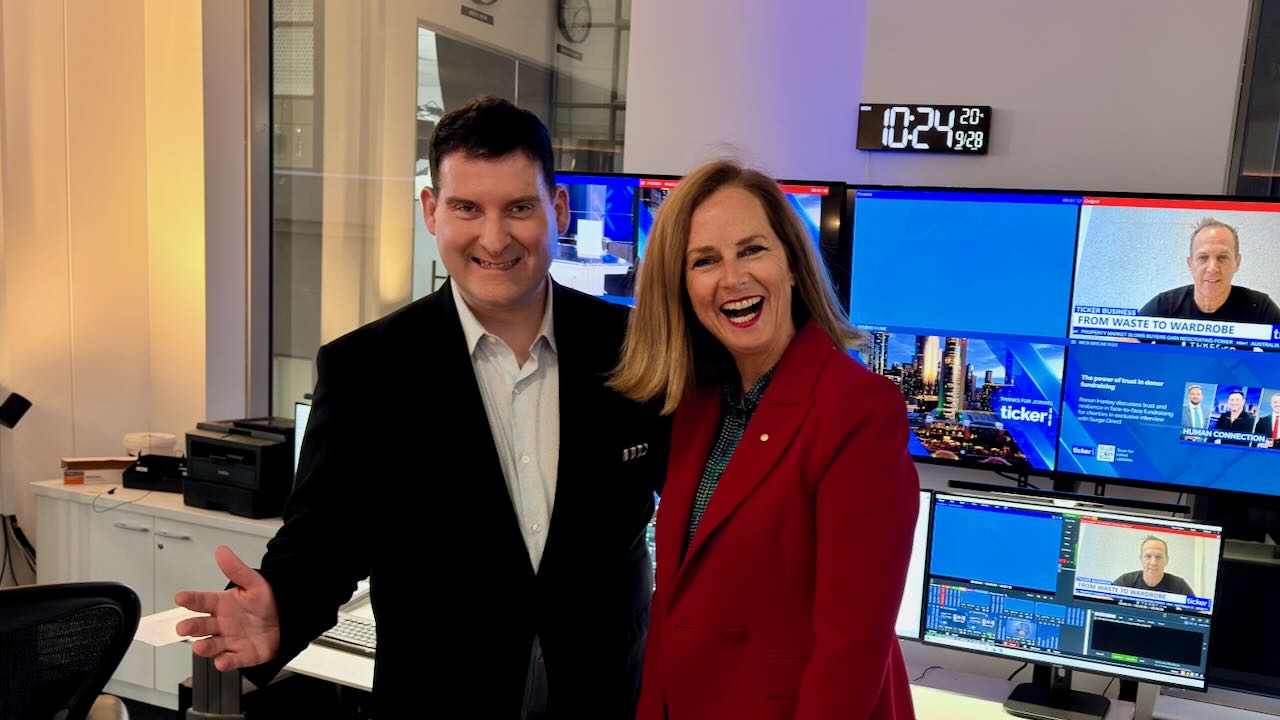
.jpeg)
I remember the moment I realised RedBalloon wasn't just in the experience business — it was in the trust business. We were about six months in when a global event rattled consumer confidence and my phone stopped ringing. Just like that. No warning, no runway. I had one choice: understand what was happening in the real world — not just my world — and adapt fast.
That lesson has never left me.
What he laid out wasn't a set of abstract data points. It was a map of the forces that are reshaping every business, every boardroom, and every bottom line right now. And if you're a founder, a leader, or a small business owner trying to build something real in this climate, this is the conversation you need to be part of.
Here's what I took away — and more importantly, what it means for you.
The Energy Crisis Is Not Going Away — And It's an Input Into Everything
Here's a stat that stopped me cold: a tanker can effectively become uninsurable because of the small but real probability it gets hit by a drone. A $20,000 drone. That's the fragility we're operating in.
The Strait of Hormuz, conflict zones, fuel supply chains — these aren't geopolitical abstractions. Petrol, diesel, aviation fuel, fertiliser, helium: every advanced economy has woken up to the fact that they need more insurance against supply shocks. More reserves. More redundancy. That means increased demand at the same time supply is constrained.
The business reality: More inflation, for longer. Three years or more. And because energy is an input into everything — from the supermarket shelf to the small business delivery run — this isn't a line item you can ignore. Central banks can't simply "look through" a supply shock of this scale.
What leaders need to do: Build your pricing strategy around energy cost volatility. Audit your cost structure now — not when the next shock hits. The leaders who thrive in economic flux are the ones who've already thought three moves ahead on input costs.
De-Globalisation: The World Is Re-Wiring and Your Supply Chain Is Part of It
We all felt the supply chain chaos of the pandemic. Just-in-time became just-a-nightmare. But what Professor Holden described is something bigger: the "hold-up problem" has gone global.
Think about it this way. Germany was 55% dependent on Russian gas. The US is 95% reliant on Taiwan for advanced semiconductors. These are not small exposures. They are civilisation-level vulnerabilities. And the response — "friend-shoring" or "on-shoring" — is expensive, slow, and still politically contested, especially under a Trump 47 dynamic where leverage matters enormously.
Australia has cards to play here — Pine Gap, critical minerals — but the arm wrestle is ongoing. Every nation is recalculating what it can safely source from where, and who it trusts.
The business reality: Supply chains built for maximum efficiency are being rebuilt for maximum resilience. That is a fundamental shift in logic.
What leaders need to do: Map your dependencies. Where are you exposed? Which suppliers are concentrated in regions of geopolitical risk? The businesses that will navigate economic change well are the ones diversifying now — not because it's cheaper, but because the alternative is catastrophic.
China's Economy: The Consumer Opportunity Hidden Inside the Headlines
Most people hear "China's economy" and either dismiss it or catastrophise it. The nuance is far more interesting.
China's GDP has grown from $426 billion in 1992 to $18 trillion today. That is an almost incomprehensible rise. But China now faces the classic "middle income trap" — growth stalls as a developing economy matures and can't simply pour capital into infrastructure and housing forever.
Here's the number that matters: the top 10% of China's population is 140 million people. That's roughly six Australias. Their income share mirrors the US top 10%. These are people who want wagyu beef, lobster, red wine, and premium experiences. If China shifts its consumption ratio — which it must, from investment-led to consumer-led growth — Professor Holden estimates an increase of $6 trillion in consumer spending.
The business reality: China's transition creates both risk (for commodity-dependent industries) and opportunity (for consumer goods, services, and experiences).
What leaders need to do: Don't write China off and don't bet everything on it. Understand where your product or service sits in the consumption shift. And remember what Professor Holden said plainly: you can count on China to act in China's interests. That's not cynicism — that's clarity.
Australia's Productivity Problem Is Our Shared Problem
This is the part that kept me up that night. We have a structural deficit of around 2% of GDP. We're running headline deficits despite relatively low unemployment and nominal GDP growth. And in Sydney — the second most expensive city in the world to build housing, after Hong Kong — productivity in construction has gone backwards by 18% in ten years.
Read that again. Backwards. By almost a fifth.
Tax reform, federation reform, housing reform — Professor Holden was unambiguous about what's needed. Tax consumption more, tax income less. Make company tax competitive. Fix the structural things that are strangling our ability to grow.
The business reality: An unproductive economy makes everything harder — hiring, expanding, competing globally. These are the headwinds your business is already swimming against, whether you name them or not.
What leaders need to do: Engage. Advocate. Know the policy landscape. Business owners who understand fiscal reality and participate in the conversation have more influence than those who don't. Your voice matters — use it.
AI: Don't Be Europe. Don't Kill the Thing That Could Save Us.
Professor Holden quoted Bob Dylan: "Don't criticise what you can't understand." He applied it directly to AI regulation.
The warning is clear: the economies that over-regulate AI now — before they even understand what it can do — will be the ones left behind. The analogy is electrification. When electricity arrived, the people who embraced it didn't just get light — they got an entirely new economic paradigm. Step-change productivity growth. The same is possible now.
The business reality: AI is not a threat to manage. It's a capability to build. Every day a business waits to integrate AI thinking into its operations is a day it falls further behind.
What leaders need to do: Get curious. Not reckless — curious. Ask what AI could do for your customer experience, your operations, your marketing. The leaders who thrive in economic change are the ones who stay in the question, not the ones who assume they already have the answer.
So What Does All This Mean for You?
I've built a business through the dot-com crash, the GFC, a global pandemic, and about seventeen other moments where people told me the timing wasn't right. What I've learned is this: the conditions are never perfect. The question is always whether you're informed enough to act anyway.
Here's my honest summary — what every business leader needs to hold onto right now:
- Energy costs will stay elevated. Build that into your model — don't hope it away.
- Supply chain resilience beats supply chain efficiency. Map your exposure before the next shock arrives.
- China is both a risk and an opportunity. Know which one it is for your business.
- Australia's structural challenges are real. Engage in the conversation; don't outsource it to politicians.
- AI is the electrification moment. Get in early — or explain later why you didn't.
The world is chaotic and change is moving faster than any of us have seen in our lifetimes. But chaos is also information. The leaders who read it well — who stay curious, stay informed, and refuse to let uncertainty become paralysis — are the ones who build businesses that last.
If it is to be, it is up to me.
And up to you.
Frequently Asked Questions
What does "economic flux" mean for small business owners?
Economic flux refers to the rapid, often unpredictable shifts in economic conditions — from energy prices and supply chain disruptions to currency movements and geopolitical realignments. For small business owners, it means the inputs you relied on (cost, supply, consumer confidence) can shift dramatically in a short time. The businesses that survive are the ones that build resilience into their model, not just efficiency.
How should leaders respond to de-globalisation trends?
Leaders should audit their supply chain dependencies, identify geographic concentration risks, and begin diversifying supplier relationships — prioritising resilience over cost optimisation. Friend-shoring (sourcing from politically aligned countries) is one strategy; building buffer inventory is another. The key is acting before a disruption forces your hand.
What is the biggest economic risk for Australian businesses in 2025?
Energy price inflation and productivity stagnation are the twin pressures most likely to squeeze Australian businesses over the next three years. Understanding your cost structure — particularly energy inputs — and finding productivity gains through technology (especially AI) are the two most practical responses.
How can business leaders prepare for ongoing inflation?
Pricing strategy, supplier diversification, and a clear-eyed audit of energy-dependent costs are the starting points. Businesses that proactively communicate value to customers — rather than simply absorbing or passing on costs — tend to retain loyalty through inflationary periods.
Why does AI matter for business leaders navigating economic change?
AI represents a step-change in productivity — the kind that electrification provided in the early 20th century. Leaders who integrate AI into their operations, customer experience, and decision-making now will have a structural advantage over those who wait. The economic environment of the next decade will reward productivity — and AI is the most accessible productivity lever most businesses have ever had access to.