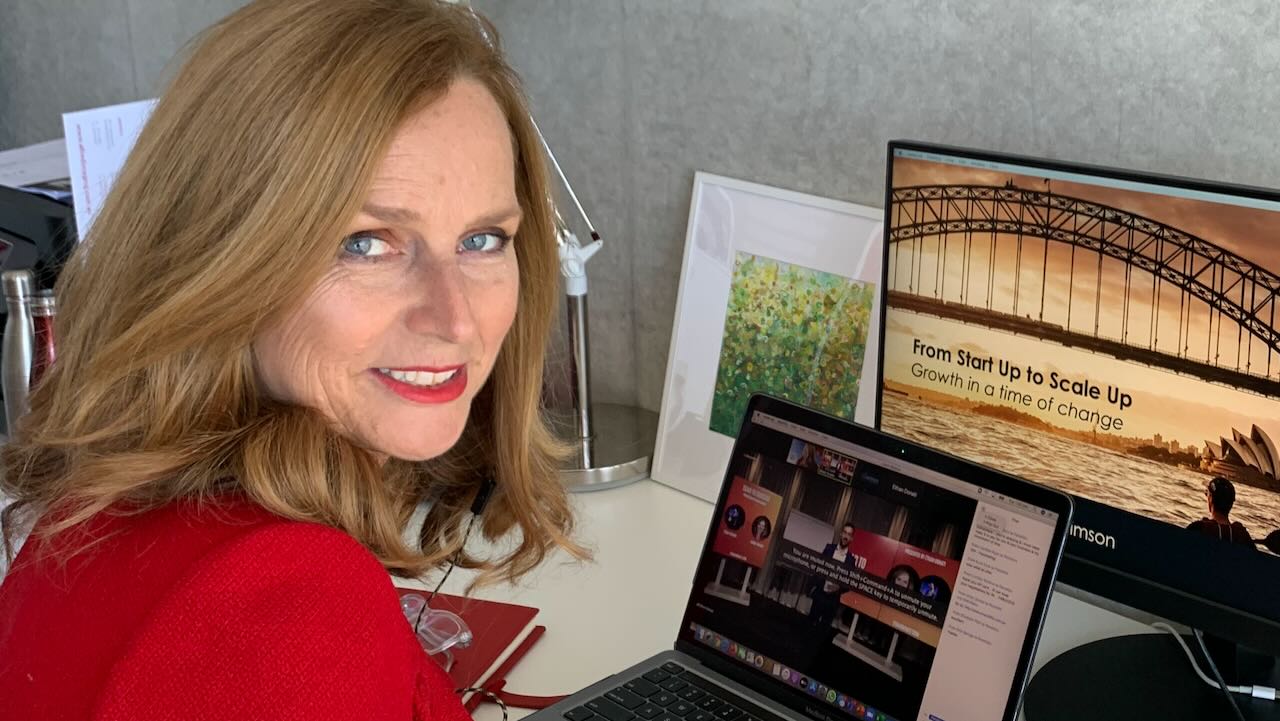
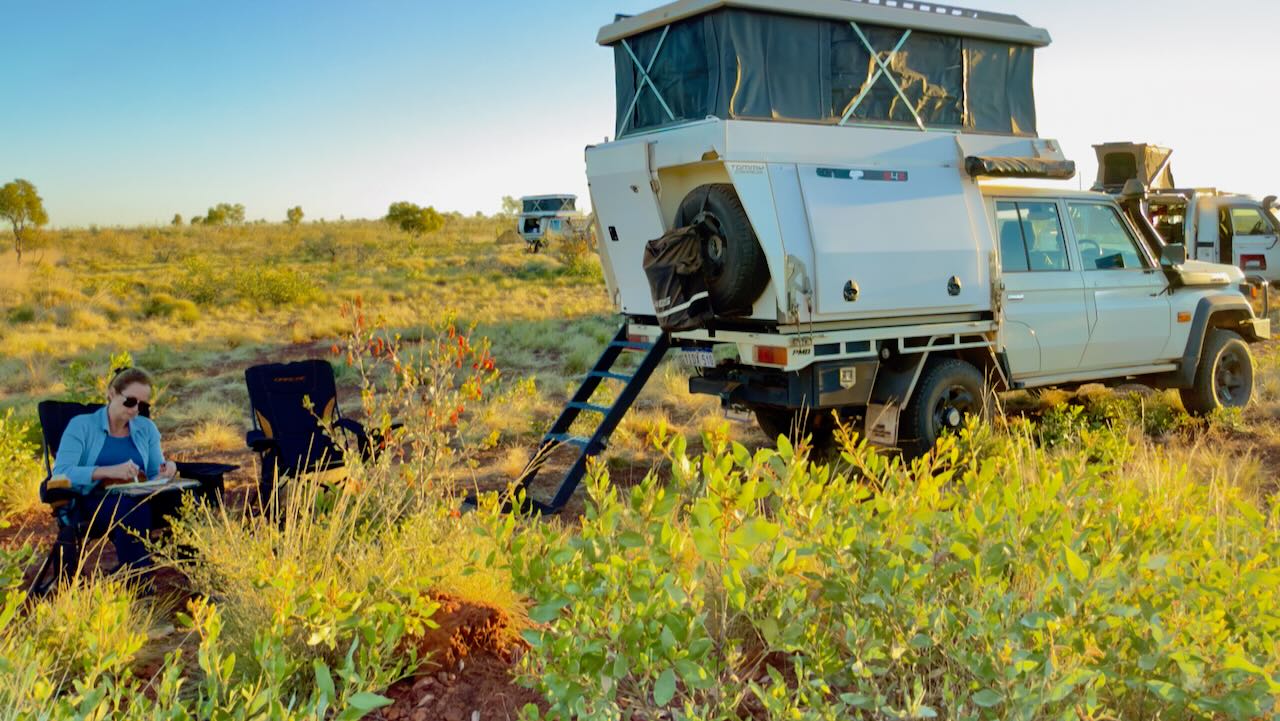
This was my version of a digital detox — ten days fully off-grid, no phone, no inbox, nothing but red earth and sky. The first thing I noticed was the absence of a small red dot. No bars on the phone, no waiting message, no soft glow from the corner of my eye. Just the wind moving across a landscape older than most things I've ever known, and the sound of a billy heating over coals for the first cup of tea. Four families, one convoy, and a stretch of red earth that swallowed our vehicles like a full stop at the end of a very long sentence.
I had packed my paints, my sketch pad, and my pencils. That was deliberate. I did not want to sit and stare passively at the Australian Outback. I wanted to look at it hard enough to mix the colour of that particular red, to catch the way late afternoon light does something almost tender to a ridge line. The decision to pack them was the same decision as the trip itself: I was choosing presence over consumption, and observation over reaction.
What the silence actually does to a busy mind
For the first two days, I kept reaching into my pocket. Muscle memory is a strange thing. My hand knew the shape of a phone that was not there, and my brain kept scanning for an inbox that could no longer be scanned. By day three, my shoulders had dropped, and I noticed that I could hold a thought for longer than ninety seconds without it being interrupted by something dressed up as urgent.
Before we left, everything had felt urgent. A deadline, a decision, a reply someone was waiting for. By day four, I could not remember what most of it had even been. What remained was different, and quieter, and more important. The people I love. The work that genuinely matters. The question of whether I am spending my time on the things I would actually be proud of at the end of the year.
The sketch pad taught me something I did not expect. When you sit and try to paint the ridge in front of you, you have to look at it for long enough to actually see it. You notice that the red is not one red, it is a dozen. You notice that the shadow moves faster than you thought. Screens have trained us to skim. The Australian Outback, and a small square of paper, retrained me to look.
This is the practice underneath continual learning as a founder's edge — the willingness to slow down enough to actually see what is in front of you, rather than assuming you already know.
Real connection only happens when there's nowhere to retreat
Four families around a fire, and no one glancing at a screen. Conversations that did not get cut off at the interesting part. Kids who ran out of screen questions by day two and started asking the adults about stars, and stories, and why the earth is red in some places and pale in others. I had forgotten how much depth is possible when there is nowhere to retreat to.
I thought about this a lot in relation to the meetings I sit in most weeks. The half-attention. The laptop open under the table. The quick glance at the watch. We tell ourselves we are being efficient. We are actually being absent, and our teams and our clients feel it, even when they are too polite to name it.
Presence is not a soft skill. It is the skill. It is what separates a leader people want to follow from one they merely report to. It is what turns a client conversation into a relationship. It is the difference between a team that trusts you and a team that manages you. Everything I care about in building a leadership culture that lasts rests on it.
The painting made me notice this again. You cannot paint from half attention. The Outback does not reward skimming. Neither do the people who work with you.

The wilderness has no manufactured urgency
Out there, urgency is real or it does not exist. Rain is urgent. A tyre is urgent. Getting the fire lit before sunset is urgent. A notification is not urgent, because there are no notifications. A metric on a dashboard is not urgent, because there is no dashboard. What is left, when the manufactured layer is stripped away, is startlingly simple. Food. Weather. Laughter. Rest. The slow discipline of mixing colour and making marks on paper.
I am not romanticising it. Ten days in the Australian Outback is not a soft experience. It is dusty, and cold at night, and physical. But that physical realness is exactly the point. In 2026, our working days have never been more mediated by screens, AI-generated inboxes, and the low hum of always-on expectation. The contrast with a landscape that has no interest in any of it is clarifying.
The paintings I made on that trip now sit in my studio as reference for future work. That is not a trivial output. It is proof to me that intentional, off grid, creative immersion produces something tangible, and that stepping away is not the opposite of doing good work — it is often the source of it. This is closely tied to why customer obsession starts with present leadership: you cannot serve people well from a depleted, distracted place.
How to build your own version of this — even in small doses in 2026
Most people cannot take ten days in the Outback this year. That is fine. The question is not whether you can replicate my trip. The question is what your own version of intentional disconnection looks like, and whether you will design it deliberately or keep waiting for it to happen by accident.
If you have a creative practice — drawing, painting, writing, playing an instrument, cooking without a recipe — treat it as a legitimate reset tool, not a hobby to feel guilty about. It is one of the most reliable ways I know to retrain attention.
Here is a simple table of options, scaled by time.
Reset formatTime requiredWhat it replacesPhone-free Sunday morning3–4 hoursWeekend scroll habitQuarterly half-day off-site (no agenda)Half a dayBack-to-back meeting cultureAnnual long weekend — no laptop3 days'Always available' expectationOne week off grid (camping, remote travel)7 daysAccumulated decision fatigueTen days fully off grid10 daysEverything you forgot mattered
Much of this is the same practical mindset I explore in what I've learned about building a high-trust team — the systems and permissions that let you step away without the wheels falling off.
What I brought home
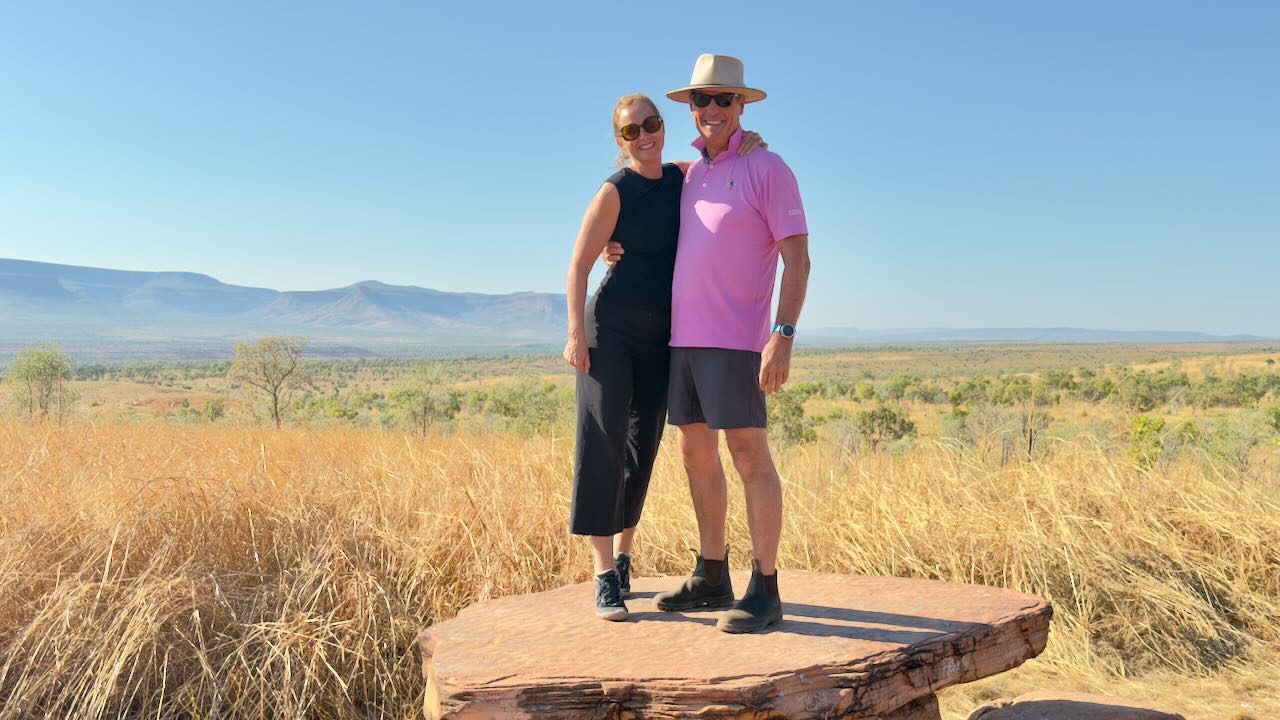
I came back with sketches, a small stack of paintings, and a clearer sense of what I want the next twelve months to be about. That is not indulgence. That is a leadership act. The discipline of choosing rest — real, deliberate, off grid rest — is one of the most underrated decisions available to a business owner right now.
If it is to be, it is up to me. No one is going to build this space for you. No calendar will politely clear itself. You have to decide, and then you have to actually pack the bag, put the sketch pad in it, and go. If any of this has landed, it is a theme I return to often in my keynote on purpose-led business.
So the question I would gently leave you with is this: what would your version of ten days look like, and what would you bring with you to make it real? Spending time with the one's we love - or getting to know new people is as valuable - after all it is about shared experience.
FAQs
Is taking ten days off actually realistic for a small business owner?
Most of us assume it isn't, and that assumption is often the thing holding us in place. The honest reframe is this: the question is not whether you can afford to step away, it is whether you can afford to keep operating on empty. With the right handover and a bit of courage, ten days is genuinely possible.
What does disconnecting completely do to your ability to think clearly?
By day three or four, thinking stops feeling like triage. Sitting with a sketch pad and studying the light on red earth is a different quality of attention than scanning a screen, and it carries back into how I read a business problem afterwards. The clarity is real, and it lasts longer than a weekend off.
How do you prepare your team before going fully off grid?
I have honest conversations well in advance, name the dates clearly, and agree on who owns what while I am away. There is no clever framework. Trust and preparation are what make it work, which is one of the reasons I invest so much in team culture in the first place.
What's the smallest version of a reset that still makes a difference?
A phone-free Sunday morning is a genuinely good start. Even one hour with a sketch pad, a walk, or an unhurried breakfast with no agenda begins to loosen the grip of the default setting. Small resets, done consistently, matter more than one big trip a year.
How do you avoid slipping straight back into the noise when you return?
Re-entry is the hardest part. I stay off the phone for the first morning back, I do not open the inbox before I have written down what I want the week to be about, and I keep the creative practice alive in small ways once I am home. Those first forty-eight hours protect everything the trip gave me.
How long should a digital detox actually last to make a difference?
There's no single right number, but from what I've experienced, day three is usually the tipping point — that's when the phone-reaching muscle memory fades and clearer thinking starts. A weekend gets you partway there. Three to four days lets the reset properly take hold. Ten days is what let me come home with something to show for it, but even one genuinely phone-free day moves the needle more than people expect.