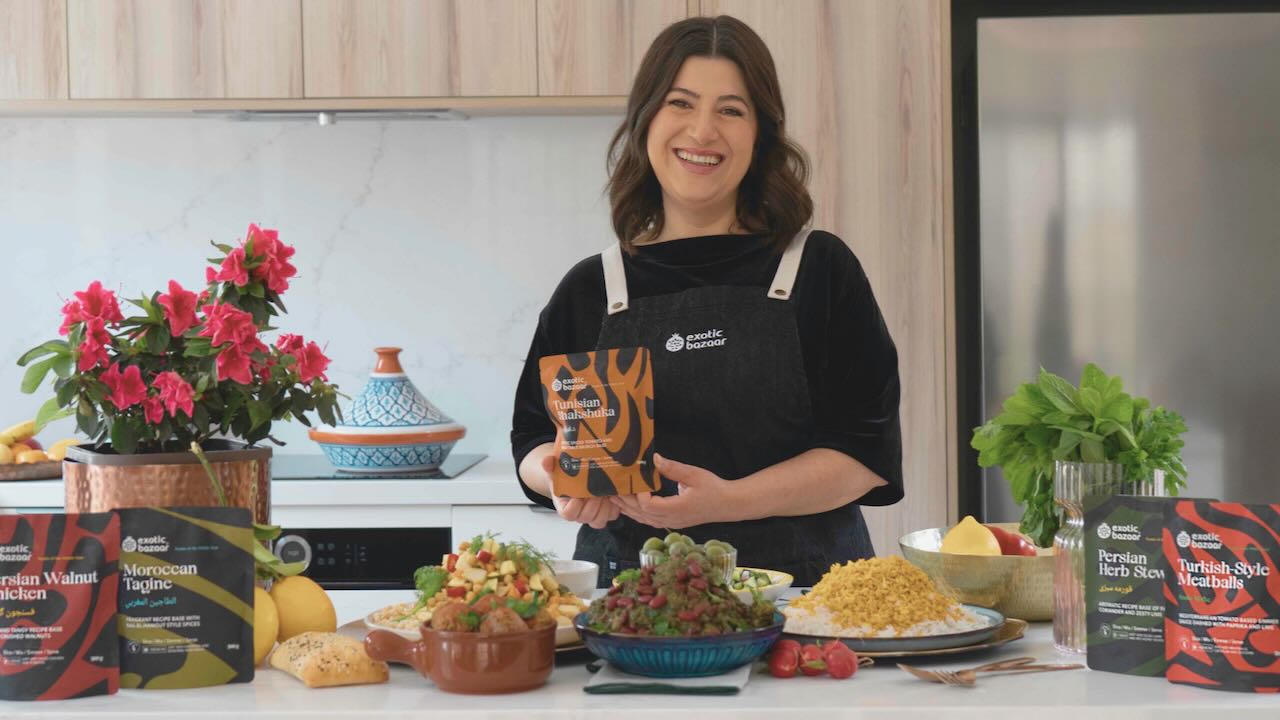
Gilava Pour started her business because she kept losing her lunch.
She was working as a data engineer, decided to stop buying lunch and bring her own, and started taking Persian food into the office. Persian food smells extraordinary. And in her culture, if somebody looks at your food, you offer it. So she would ask — would you like to taste? — and they would say yes, and within days she was handing out her entire lunch to the office and going down to the supermarket to buy something for herself.
It was on one of those walks down the supermarket aisle that she noticed the gap. Australia is spoilt for multicultural food. But Middle Eastern and North African cooking was barely there.
She went and found out why, and the answer was not indifference. It was intimidation. Open a Middle Eastern cookbook and you are looking at a long ingredient list, a trip to a specialty shop, a dozen steps and a real risk of getting it wrong. People were not uninterested. They were put off.
That is a distinction worth holding onto, whatever you sell. There is an enormous difference between a market that does not want you and a market that finds you hard work.
So she started Exotic Bazaar to make Middle Eastern cooking easy for everyday Australians. Six hard years later she is in Coles, she is in regional Victoria, and she has a goal I love: she wants Australians to cook Middle Eastern once a week. Middle Eastern Monday.
She brought me three questions that I suspect a great many product founders are sitting on right now.
Count the Fixed Costs Before You Count the Savings
Gilava currently outsources most of her manufacturing across four or five companies, with four people in her own team. She wants to bring production in-house to Ballarat, where she hopes to employ eighteen to twenty people. Her question was how you know when a business is ready for that kind of investment.
It is the same question anyone faces when they move from paying for a service to owning the capability — a warehouse, a delivery fleet, a studio, a kitchen. Here is the order I would work through it.
Start With Compliance, Not With Cost
You already know from your suppliers what workplace safety, health and food safety regulation looks like, and it is onerous. Find out precisely what it will cost you and what will be required of you before anything else, because this is the piece people leave until after they have signed a lease.
AI is genuinely good at helping you find the right questions to ask the right authorities, even if you would not rely on it for the answers.
Work Out What Your Fixed Costs Demand of You
Manufacturing turns variable costs into fixed ones. A lease. Equipment. A workforce.
So the real question is: what is the minimum volume must I sell, at what margin, to cover those before anything else happens? Run that number honestly. It may tell you the answer is not yet, and not yet is a perfectly good answer.
Why a Cash Flow Forecast Matters More Than a P&L
Then do a cash flow forecast, which is not the same thing as a profit and loss statement. A P&L tells you whether you made money over a period. A cash flow forecast tells you whether you will have money in the bank on the day the rent, the wages and the ingredients all fall due.
This matters enormously for Gilava because she is selling into a major supermarket. Large organisations do not always pay a small business inside seven days. You buy the ingredients, you pay the staff, you deliver the stock — and the income arrives weeks or months later. Every one of those costs is now fixed, and none of them will wait for the retailer.
Profitable businesses run out of cash all the time. It is one of the most common ways a growing business dies, and it is almost always visible in advance if somebody bothers to forecast it. If building that forecast is not your gift, pay a specialist a few hours to build it with you. It is one of the cheapest pieces of insurance in business.
Regional and Small Business Grants: Free Money for a Phone Call
Because Gilava is in regional Victoria, she should be talking to the local council and working out which government authority is accountable for regional employment. Victoria wants jobs in the regions. There may well be grants or support for exactly the setup she is planning.
Founders skip this constantly, usually because they assume grants are for somebody else, or that the paperwork will swallow a month. Make the phone call first and find out. It costs you an hour.
Do It in Stages
Then think about quality, because in food the product has to speak for itself. Somebody has to feel they are having an authentic Persian experience. People notice when ingredients get quietly downgraded, and once that trust goes it does not come back.
And I would look hard at whether this has to happen all at once. Take one line, or a few lines, in-house before the whole range. Step into it. Learn what you did not know you did not know, at a scale where being wrong is survivable.
One last thing on this, and it is personal. Somebody in the office said to me recently: you were employee number one. No, I said — I was more like employee number forty-five, because I did not pay myself for the first ten years. I do not recommend that. And when I look at how capital gains is treated, I am not sure anyone in government has ever costed the sweat we put into these businesses, because that free labour never appears anywhere. If you are not covering your fixed costs, it is very hard ever to get to a salary.
The Love and Loathe List
Gilava's second question was the founder's question, and it belongs to every founder regardless of industry. She is the face of the brand. She does the education, the decision-making, the accounting, all of it. She knows she has to delegate and she is worried about losing the authenticity and the quality control that make it hers.
There is a film I keep coming back to — The Intern, with Robert De Niro and Anne Hathaway. Everyone loves it because we feel for the Hathaway character. She loves her business so much that she is very nearly strangling it. And the thing is, that love is also what makes it great.
So the real question is: how do you pass on the soul?
Start by naming your non-negotiable. For us, the soul came down to something almost embarrassingly simple: we did what we said we were going to do. That was it. And my own motto has always been if it is to be, it's up to me — meaning I stand by my word and people can count on it.
Being able to say that out loud, to everyone around you, is what lets you delegate. Because delegation is a trust problem, not a process problem. Letting people do things their own way is hard precisely because it is not our way — but ours is just a way, not the only one. Some things must be exact: recipes, quality, food safety. But if somebody builds a marketing presentation differently from how you would have, that is not wrong. It is different. And we find that very hard.
Then look in the mirror and admit you are not the expert in everything. What do you love? What are you genuinely strong at? That is what you should be spending your time on. The rest needs somebody else — and not necessarily an employee. It might be a specialist doing one thing, like a cash flow forecast, if that is not your gift.
I used to write a love-and-loathe list. What do I love, what do I loathe. Now, with the tools available, I go through the loathe column and ask: should I build this, buy this, or hire for this? Do not rush to an employee. Gilava's outsourced manufacturing model is a good example of getting scale without overhead, and she should not be too quick to abandon that instinct.
Then find out what the people around you love and loathe. There is a book called StrengthsFinder 2.0 — the assessment inside it is now formally called CliftonStrengths. Not new, very inexpensive, and it still works. We had our whole team do it. I am a big picture person, so I needed somebody brilliant at detail. That is not a compromise. That is a complement.
And once you accept you are not best at everything, something shifts. You stop delegating and start allowing people to do their jobs. It is no longer "here is what I'm telling you to do." It is "here is a job that needs doing and you are the best person for it." Which means when they do it, you get to thank them for the contribution — and that is the part that keeps good people.
When Customers Speak, Buyers Listen
The third question is the one I found most interesting, and it applies to anyone selling through somebody else's shelf, platform or catalogue.
Exotic Bazaar is in Coles, but sitting in the world foods aisle. To the buyers, and to some shoppers, that still reads as fringe. Gilava is going for mainstream.
Every packet is a marketing opportunity. Not for a discount code — for a conversation. Ask people what they thought. Ask them to send you a photo. Then take those replies and put them everywhere: social, website, and in front of the buyers. The story you want is I cannot believe I made this pilaf, and I cannot believe how easy you made it. That is worth more than any claim you could write yourself.
Then there is the move most founders never make, and it is the one I would prioritise. Ask your customers to contact the buyer.
Someone finds the product in the world foods aisle, or online, and loves it. Tell them: if you have not seen this in your local store, here is who to email. Because buyers live and die on the zeitgeist of what is in demand, and demand expressed by actual named customers is a completely different signal from a supplier asking for more facings.
You also have a community who can become advocates. Have you got an auntie in Queensland? Genuinely — that halo effect of customers finding customers is how a regional brand goes national without a media budget.
Middle Eastern Monday
And underneath all of it is a purpose bigger than the packet.
Middle Eastern Monday is the best idea in this whole conversation, and it costs nothing. It is a habit, not a product. It gives people a reason to buy on a schedule rather than on a whim, and it gives the buyer a story about frequency rather than novelty. Get people saying it and half the work is done.
Every strong consumer brand has a version of this. Find the sentence your customer says to somebody else, and then make it easy to say.
Food Is a Great Equaliser
Gilava wrote an article arguing that social cohesion starts at the dinner table, and it got attention, because it is true. You try food from a different culture, you have a small conversation, and suddenly the unfamiliar is a great deal less frightening.
I know exactly what she means. My first job was with IBM in New York, and my flatmate was Colombian. I had never met a Colombian, and at the time the reputation that preceded them was drug runners and worse. Then I came home from work one day and his father was sitting there in slippers, reading the paper and drinking a beer, exactly like my dad. And the world got smaller. We shared food and we shared coffee, and in that moment it was just — we are all humans, mums and dads, feeding our families and getting by.
Nothing is very foreign once you have tasted it.
Thanks again to Odoo for supporting this season of Handpicked. If you’re running a growing business, you’ll know how frustrating it can be when your systems don’t talk to each other and too much of your time disappears into administration. To learn more
Frequently Asked Questions
How do you know when to bring manufacturing in-house?
Work through it in order: what compliance and food safety will cost you, what your new fixed costs are, what minimum volume and margin covers them, and what your cash flow looks like when a large customer pays on their terms rather than yours. If the numbers only work on optimistic volume, it is too early.
Why does a cash flow forecast matter more than a profit and loss?
A profit and loss statement tells you whether you made money over a period. A cash flow forecast tells you whether the money will be in the bank on the day you need it. When you sell to large customers who pay on long terms, you carry every cost up front and see the income much later — which is why profitable businesses run out of cash.
Should a small food business move all production in-house at once?
Usually not. Take one line or a few lines in-house first, learn what you did not anticipate at a survivable scale, and expand from there. It also gives you a real cost base to plan the rest from, rather than an estimate.
Are there grants for small businesses setting up in regional areas?
Frequently, and founders routinely fail to ask. Start with your local council and whichever authority is accountable for regional employment in your state. Governments want jobs outside the capital cities, and support for a business creating them is often available. It costs an hour to find out.
How do founders delegate without losing what makes the business special?
Name your non-negotiables — the handful of things that must be exact, and the principle underneath how you work — and be explicit about them with everyone. Then accept that different is not the same as wrong. Delegation fails on trust far more often than it fails on capability.
How do you decide what to hand over first?
Write a love-and-loathe list. What you love and are strong at is where you belong. Everything in the loathe column becomes a question: build it, buy it or hire for it? Not everything needs an employee — a specialist for a few hours a month often solves it.
How do you get a product moved out of the world foods aisle into mainstream ranging?
Generate demand the buyer can see. Use packaging to collect customer stories, publish them, and ask customers who cannot find the product locally to email the buyer directly. Retail buyers respond to evidence of consumer demand far more readily than to supplier requests.
Listen to the full episode with Gilava Pour of Exotic Bazaar