
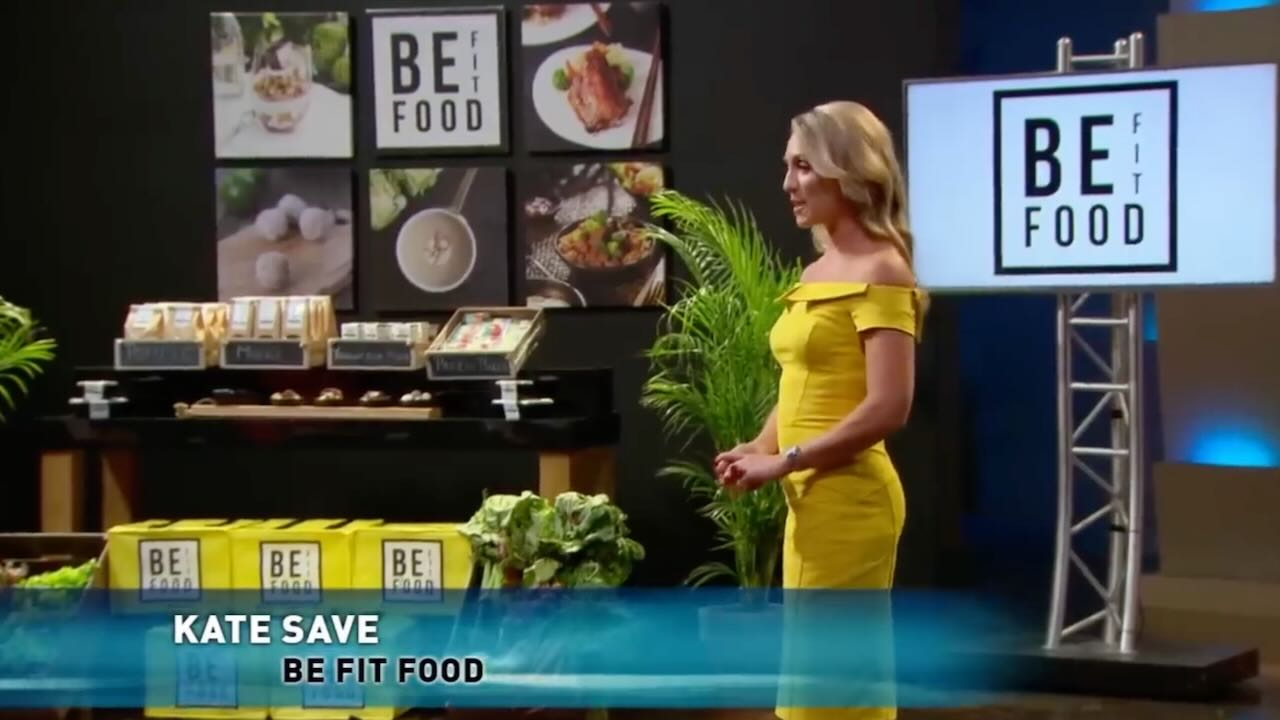
One of the questions I am asked most often is this: whatever happened to the people we saw on Shark Tank? So I thought it would be fun to go and find out. Kate Save pitched Be Fit Food in 2017. Nearly a decade on, she joined me on Handpicked to talk about what came next — and what overnight growth really costs a founder.
Kate is a dietitian, exercise physiologist and diabetes educator. She and her business partner, a weight loss surgeon, had built something genuinely new in the Australian market. She walked into the tank looking for investment. What she was not expecting was customers.

By Kate's account, 60,000 people hit the Be Fit Food website within the four minutes she was on air. Both Steve Baxter and Janine Ellis made offers, and she took Janine's. Then the real work started.
The devil is in the detail
Kate tells me that within four weeks of the episode going to air, she went from a team of five to 63 people. Three warehouses. Multiple kitchens. From home delivery in Victoria to national delivery inside a few months. And from somewhere around 1,000 to 1,500 meals a week to 30,000.
What she had to learn in that period had nothing to do with food. It was how many amps the building could carry, because she kept blowing the power. It was that a diesel truck you plug into the wall still needs diesel in it, and that when one goes flat over a weekend you need someone with a truck licence to sort it out. Cold chain. Forklifts. Certifications.
This is the part founders rarely hear about. You can be the world expert in your product and still not have the systems to deliver on your customer promise at scale. The promise is the easy bit. Fulfilling it, every time, at volume, is a completely different business.
Kate's own words on it: never wish for rapid growth overnight.
Choose the investor for the gap you have not hit yet
Kate chose Janine for good reasons — food experience, a female founder, someone who understood scaling in an industry Kate was finding hard. Sensible thinking.
But the morning after the episode aired, the website went down. Then it went down again. By Kate's telling it kept crashing every ten to thirty minutes for six weeks. The next two years went into building the technology platform, because that was the thing standing between the product and the customer.
Steve Baxter, of course, is the tech one.
I am not saying she chose wrong. I am saying the constraint that nearly broke the business was the one she had not priced in. When you bring an investor in, you are hiring for a gap. The honest question is not which gap has already hurt you. It is which one is coming next.
Build a brains trust before you need one
I have been in a version of this. Website stability is everything — customers have arrived, and it has cost us a great deal of money to get them there, so the very least we can do is open the doors. But I did not know who to trust. One vendor told me to be a Microsoft house. The next told me Google. Everyone had an opinion and every opinion came with an invoice.
So I built a technology advisory board. Clever heads, none of them investors, none of them employees. I bought them a good lunch and they told me a great deal. What they gave me was not answers — it was the right questions to ask my own team.
If you are working out how to scale a business and you are not sure where the risk sits, start by naming your non-strengths honestly. Then work out who could fill that gap. Most people are generous if you ask them well.
In an age of AI, how does anyone know you are real?
Kate's answer is proof. Be Fit Food's meals were used in a randomised controlled trial run by Deakin University's Food & Mood Centre, comparing a food-based very-low-energy diet with a supplement-based one. It was published in Cell Reports Medicine in October 2025. It is a small, three-week study, and its findings sit with the researchers rather than with me. But the principle is what matters here: Kate went and got independent evidence, and now she can point to it.
That is the lesson for any business, whatever you sell. What are your proof points? What is the guarantee, the warranty, the research, the collection of customer stories? How does a stranger know you are real?
There is a flip side, and it is the one I live with. People have called me the RedBalloon Lady for twenty years. I have a name. Founder energy is powerful and a brand with a face earns a trust that a faceless one has to work much harder for — but the business cannot only be the founder. I have not worked in RedBalloon for more than a decade. That separation was deliberate, and it is rarer than it should be.
Nearly ten years on from the tank, Kate is delivering tens of thousands of meals and describes a national retail rollout underway. She thought the consulting was the business and the product was the side hustle. It turned out to be the other way around.
Thank you to Ozoo for supporting Australian business owners through its sponsorship of Handpicked.
Watch the full conversation on YouTube.
Frequently Asked Questions (FAQs) on Kate Save and Be Fit Food
Who is Kate Save from Be Fit Food?
Kate Save is an Australian dietitian, exercise physiologist and diabetes educator, and the co-founder of Be Fit Food. She appeared on Shark Tank Australia in 2017 and has led the business through national expansion in the years since.
What happened to Be Fit Food after Shark Tank Australia?
Kate describes extraordinary growth in the weeks following the episode: a team that went from five people to 63, three warehouses, and a jump from around 1,500 meals a week to 30,000. The operational and technology challenges of that pace took the next two years to work through.
Which Shark invested in Be Fit Food?
Both Steve Baxter and Janine Ellis made offers. Kate accepted Janine Ellis's investment, choosing her for her experience scaling food businesses and her perspective as a female founder.
What are the risks of scaling a business too quickly?
Speed exposes every weakness in your operations at once. Kate's experience is a clear example: expertise in the product does not translate into capability in logistics, warehousing, technology or compliance, and each of those has to be built or bought before the customer promise breaks.
How do you choose the right investor for your business?
Look at the constraint ahead of you, not the one behind you. Investors bring capability as well as capital, so the question is which gap will most limit your growth over the next two years — and who can genuinely close it.
A note on the facts in this piece: the figures above are Kate's own recollections of her business, given in conversation. I have checked the research she mentions and linked it so you can read it for yourself — it is published in Cell Reports Medicine by Cell Press, and is sometimes described elsewhere as a Lancet publication, which it is not.